
What to Do With Your Adult Children's Belongings When You Downsize in Greater Victoria

Andrew Holenchuk
Victoria Property Group · eXp Realty
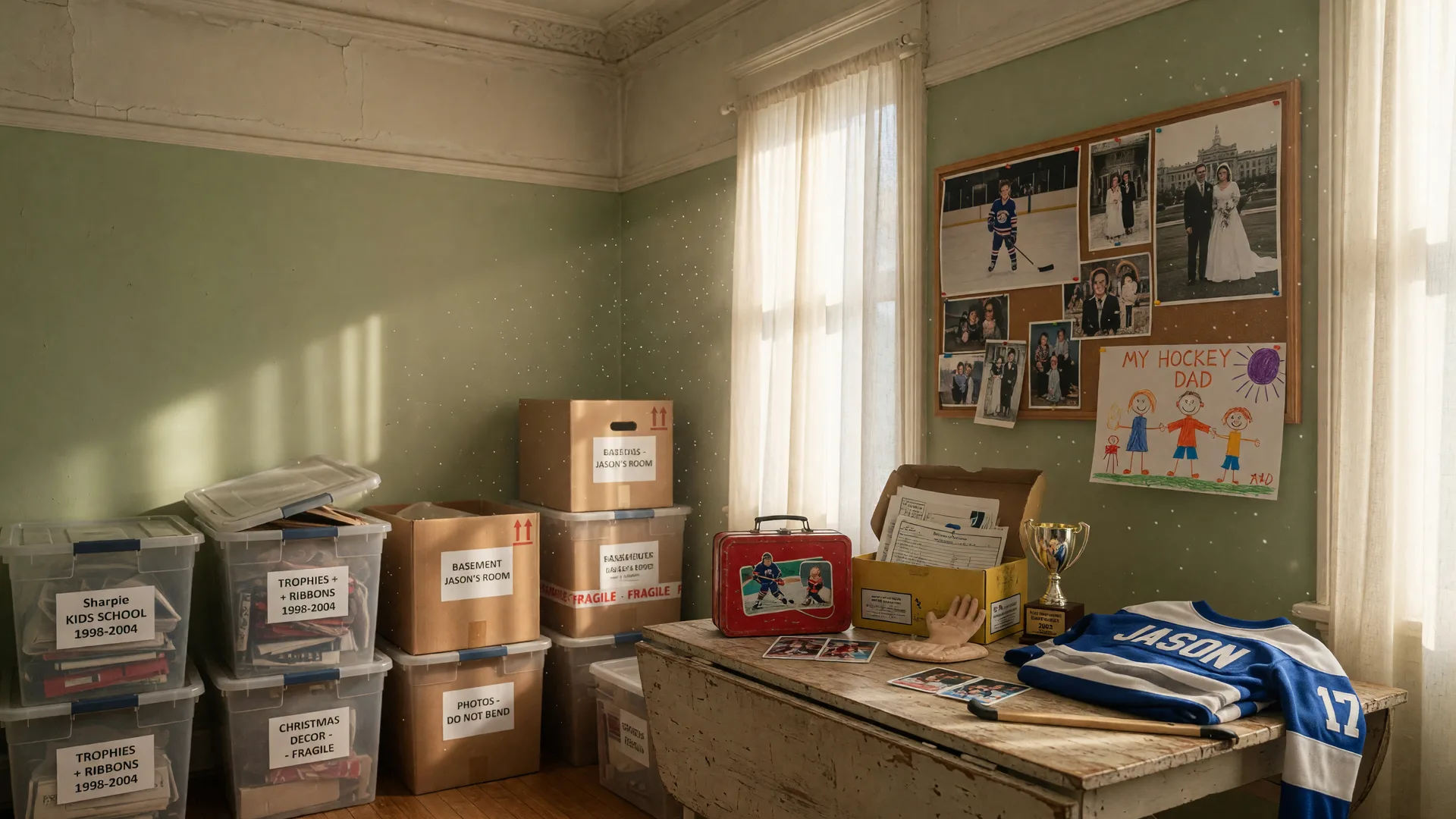
Almost every downsizing home in Greater Victoria has a version of the same room: the bedroom that is still "theirs," the basement bins of school art and trophies, the boxes of books and childhood treasures that moved out of the house years ago when the children did, but never actually left. Sorting your adult children's belongings is often the most emotionally loaded part of a housing transition, because every box carries a question about love, memory, and letting go. This guide is about handling that stuff with warmth, honesty, and a plan, so the process strengthens your family instead of straining it.
The good news is that this is a solved problem. Families across Victoria, Saanich, Oak Bay, Sidney, and Langford work through it every year, and there are clear, kind ways to do it. The key is to start with the conversation, not the boxes.
Why their stuff is the hardest stuff to sort
There are two layers to every bin of adult children's belongings. The first is practical: the items themselves, which may or may not have value or use. The second is emotional, and it runs in both directions.
For parents, the boxes hold the physical evidence of childhood: the first jersey, the school projects, the books read aloud at bedtime. Letting them go can feel like erasing a chapter of family history. For adult children, the same boxes can carry guilt: guilt about leaving the sorting to you, guilt about not wanting things that once meant something, and sometimes guilt about the fact that they have not thought about those boxes in years.
Naming this out loud helps. This is not about whether your children love you, or whether you loved their childhood. It is about deciding, together, what belongs in your new home and what has served its purpose. When both sides understand that, the sorting becomes far lighter.
Start with the conversation, not the boxes
Before you touch a single bin, talk to your adult children. The goal is not permission; it is clarity and inclusion. A simple, honest conversation covers four things:
- What is happening. You are downsizing, the new home is smaller, and their belongings need a decision.
- What they want. Ask them to name the things they genuinely want to keep. You may be surprised: the items they treasure are often not the ones you expect.
- What is realistic. Be honest about space. A condo in Victoria does not have room for a childhood's worth of belongings, and that is not a failure on anyone's part.
- A deadline. Give them a clear date to claim what they want. "Please sort through your things by the end of the month" is kind. "We will deal with it someday" is not a plan.
For children who live out of town, in Vancouver, Calgary, Toronto, or beyond, use a video call to walk through the room together. Seeing the boxes on screen makes the decision concrete in a way a phone call cannot, and it lets them point to the specific things they want saved.
Sort into four clear categories
Once the conversation has happened, the sorting itself becomes mechanical. Use four categories, and label every bin as you go:
- Take with you. The things your children want, plus the keepsakes you want to keep close. Aim for one bin per child, or a single shelf of treasures, not a room.
- Ship to them. The things they want but cannot collect in person. Be realistic about shipping costs before you promise a full bedroom's worth.
- Store. A small, time-limited amount that genuinely needs a decision later. Use storage sparingly; it can quietly become a bill you pay on your past.
- Let go. Everything else, through donation, sale, or responsible disposal. This is usually the largest category, and that is normal and healthy.
The single most useful habit is to sort with a deadline in each hand: a date for the children to claim things, a date for shipping, and a date for donation pickup. Decisions made against a calendar are far easier than decisions made against an open-ended "someday."
Keep the best, release the rest
When the children have claimed what they want, you still face the larger pile of the rest. The kindest approach is curation: keep the best of the best, and let the rest go with gratitude.
- One bin per child is enough. School art, a favourite book, a team jersey, a handful of photos. Curate rather than collect.
- Photograph before you let go. A photo of the hockey jersey or the school project preserves the memory without the physical object. A shared family album of these photos can mean more than the boxes ever did.
- Pass keepsakes to grandchildren. The toy that delighted your child may delight their child. Ask before assuming, but grandchildren are often the natural next home for the best pieces.
- Donate locally. Organizations across Greater Victoria welcome gently used clothing, toys, furniture, and sports equipment. Big Brothers of Greater Victoria, Beacon Community Services, the Women's Transition House, and the Mustard Seed all accept donations that directly benefit local families.
For the items that cannot be donated, a responsible disposal service or a local charity pickup handles them cleanly. Our guide on finding new homes for a lifetime of possessions compares donation, consignment, and estate sale options across the region.
Shipping belongings to children who live away
If your children live in another province or country, decide what is actually worth shipping. A few principles keep this sane:
- Ship small, sentimental, or valuable items. Photo albums, jewellery, the baby book. These are worth the courier cost.
- Skip bulky, replaceable items. Furniture, bookshelves, and boxes of old textbooks usually cost more to ship than they are worth. Your child can replace a bookshelf in Calgary for less than the freight.
- Compare services. Canada Post, couriers, and bus freight all move parcels to other provinces. Get quotes for the actual boxes before you commit.
- Insure what matters. For genuinely valuable or irreplaceable items, insurance is worth the few dollars.
A good rule of thumb: if you would not pay the shipping cost yourself to receive the item, it probably should not be shipped. The things that matter most are almost always small enough to fit in a suitcase or a single box.
Storage: when it helps and when it hurts
Storage units are tempting during a downsizing move, and they genuinely help in narrow situations: a short timing gap between your sale and your purchase, or a few items awaiting a decision. They hurt when they become a permanent holding pattern for things no one wants.
If you are considering storage for your children's belongings, ask one question: what is the plan for these items, and when will it happen? If the answer is "we will decide later," the storage unit is really a bill you are paying on your past. A bin or two of true keepsakes is reasonable. A unit full of undecided boxes is how downsizing budgets quietly leak. Our article on renting a storage unit after downsizing walks through when it genuinely helps and how to use one wisely.
A gentle note for the adult children reading this
If you are the adult child whose stuff is in your parents' home, this article is for you too. Your parents are not trying to throw your childhood away. They are trying to make a big, emotional move, and your belongings are part of the weight they are carrying.
Here is what helps: claim your things early, even if it is just to say "you can let the rest go." Be specific about what you want saved. Offer to help sort, in person or by video call. And be gentle with yourself and them about the things that go. The memories are not in the boxes; they are in the stories you tell, and those travel with you anywhere.
Frequently asked questions
How much notice should I give my adult children before sorting their things?
Give them a clear, reasonable deadline, usually two to four weeks, and put it in writing so there is no ambiguity. "Please claim what you want by the end of the month" is fair. The deadline is not a threat; it is the structure that lets everyone move forward without guilt.
Can I send their belongings to another province?
Yes, through Canada Post, couriers, or bus freight, but be selective. Ship small, sentimental, or valuable items, and compare shipping costs against the value of the items. Bulky, replaceable furniture and boxes of books usually cost more to ship than they are worth.
What if my child is upset about what I kept or let go?
Lead with the conversation before the sorting, and keep the lines open after it. If a specific item matters to them, it can often still be saved, photographed, or retrieved. The goal is not a perfect outcome; it is a shared decision made with love, and most families find that honesty about space and money makes the letting go easier for everyone.
Should I keep a bedroom for visits when I downsize?
That depends on your new home and your family's rhythm. Many downsizers find that a condo with a guest bed, a pull-out couch, or a den that converts gives visiting family a place to stay without the upkeep of a full spare room. Talk to your children about what visits actually look like before you decide how much space to reserve.
What if my adult children don't want any of their belongings?
That is more common than you might think, and it is not a rejection of you or their childhood. It usually means they have built their own lives and their own homes. Take them at their word, keep a small curated bin of the best keepsakes, and let the rest go through donation. The memories stay with the family either way.
Sorting a family home takes time, patience, and a plan.
I've helped many Greater Victoria families work through the belongings, the conversations, and the move itself. If you'd like a steady hand and a clear timeline for your housing transition, I'm here to help. Helping people confidently navigate one of life's biggest housing transitions is what I do every day.
Let's Talk About Andrew Holenchuk
Andrew is Team Leader of Victoria Property Group at eXp Realty and has been helping people buy and sell homes throughout Greater Victoria since 2006. Together with his team, they have facilitated more than $1 billion in real estate sales while helping families navigate downsizing, estate transitions, and housing moves. This article is general information only and not a substitute for professional financial, legal, or real estate advice for your specific situation.